If you are a lover of printed words, you would know how much of your time is taken by books alone. Then one day, sooner or later, you discover a huge vacuum within that you know next to nothing about other art forms. This blog is an attempt to fulfil one such lacunae in the art of painting. We intend to look up a random painting and upload it with a link here every day whilst having our daily cuppa coffee. In this way at least we hope to be better acquainted with colours, colourers and the schools than what we are now.If you wish to be a part, you know where to shout.
Helene Fourment in a Fur Coat,
Peter Paul Rubens
What did Paul Rubens have in mind when he thought of painting Helene such? Surely not the pleasure of a generic observer who might have been more pleased with a traditional rendering of the naked female body; in other words, the standard nude. Instead, Rubens has given this painting such a feeling of intimacy that one feels like an intruder to even look at Helene who is directing a meaningful glance elsewhere.
In writing about the difference between painting nakedness and nudity,
John Berger opens a new way of looking at the nude in painting. Is she naked? Or is it another nude? Who is it intended for?
Helene Fourment in a Fur Coat is an 'exceptional painted image of nakedness', says Berger in
Ways of Seeing.
Her body confronts us, not as an immediate sight, but as experience - the painter's experience. Why? There are superficial anecdotal reasons: her dishevelled hair, the expression of her eyes directed towards him, the tenderness with which the exaggerated susceptibility of her skin has been painted. But the profound reason is a formal one. Her appearance has been literally re-cast by the painter's subjectivity. Beneath the fur coat she holds across herself, the upper part of her body and her legs can never meet. There is a displacement sideways of about nine inches: her thighs, in order to join on to her hips, are at least nine inches too far to the left.
Rubens probably did not plan this: the spectator may not consciously notice it. In itself it is unimportant. What matters is what it permits. It permits the body to become impossibly dynamic.
The structure of the naked body looks like a nod to
Venus de'Medici says Wikipedia.
A
s you would find on the Header, we started this site with a view to make ourselves more acquainted with the different painting schools and painters. Assorting paintings here over the last few years has been immensely fruitful as well as enjoyable. It has not only given us a good fundamental grasp of the history but also enabled us to appreciate and judge art , both the skill and the context.With that purpose served, it would only be pointless to assort a painting everyday. Instead we propose to spread it out over random days to upload paintings that we find interesting, either the painting itself or its artistic background. We will also share along information in the form a brief missive of why we find it interesting.
Thank you. ****
Today being the day of 500 years of Sandro Botticelli’s death, I’m kicking off the venture by uploading what could arguably be one of the greatest paintings of renaissance and perhaps of all time. The Birth of Venus. The Birth of Venus which Botticelli drew from the Venus Medici has become , to use a modern term, gold standard to represent beauty esp. feminine beauty. It is believed that the Botticelli painted Venus entirely from memory, modelling her after his love interest Simonetta Vespucci nine years after her death. Simonetta was a great beauty of her times and was married to a nobleman Marco Vespucci. Well, given her beauty it is said that she courted a number of men including Botticelli. However, it isn’t clear if they did have a relationship or an affair. But it is said she had such a tremendous impact on Botticelli that he painted her portraits including Birth of Venus after her death. She died at a young age 22 , suspected of pulmonary Tuberculosis.[1] He remained unmarried throughout his life and after his death was buried near Simonetta’s grave as per his request. Details, as of any such medieval affairs often tend to be hazy and hence controversial.[1] I am reminded of John Keats , another young victim of Pulmonary Tuberculosis. He died aged 25 studying medicine . Interestingly Keats has been buried in Rome, Italy where he died. Quite strangely both Keats and Simonetta - young victims of TB - were key figures in two important artistic movements in human history , namely, Renaissance and Romanticism.

One of the famous
Tarsila do Amaral paintings - Nude and Cactus. Love the perspective moving proximo-distal on the human nude. The Toe is bigger than the face, yet amazingly aesthetic. A tribute to early 20th century experimentation.
I must apologize for my patchy contributions to the group here. Hopefully, I should be able to contribute more regularly. I had been thinking about doing a series on South American painters and while was looking about stumbled upon the brazilian painters. I was surprised to see how little we knew about them. Hence the following:
Starting with the well known
Independence or Death by
Pedro Americo, which depicts the moment of Independence for Brazil from Portugal.

Independence or Death,
Pedro Americo
Cristina of Denmark, 1538,
Hans Holbein the Younger
Notes: Apparently Holbein executed this painting in three hours. Cristina was a prospective bride for Henry VIII (
read more)
The Card-Players, 1595,
Caravaggio
Notes: Card-Players was a very popular theme and many paintings have used this theme in very interesting ways. Worth doing an entire series on.
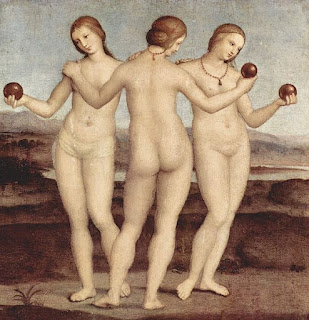
The Three Graces, approx 1505,
Raphael
Suicide of Lucretia, 1515,
Titian